

New Bern annexed land into the city limits, approved a $5 million financing agreement for vehicles and equipment, talked about a no-wake zone, and approved several items on June 9.
The New Bern Board of Aldermen rezoned property; initiated the upset bid process to sell city-owned properties; added animal service uses to the land use ordinance; approved the CDBG Annual Action Plan, and the submission of a $2 million Power-Up grant request; talked about a no-wake zone in Brices Creek Quarry; and more on June 9, 2026.
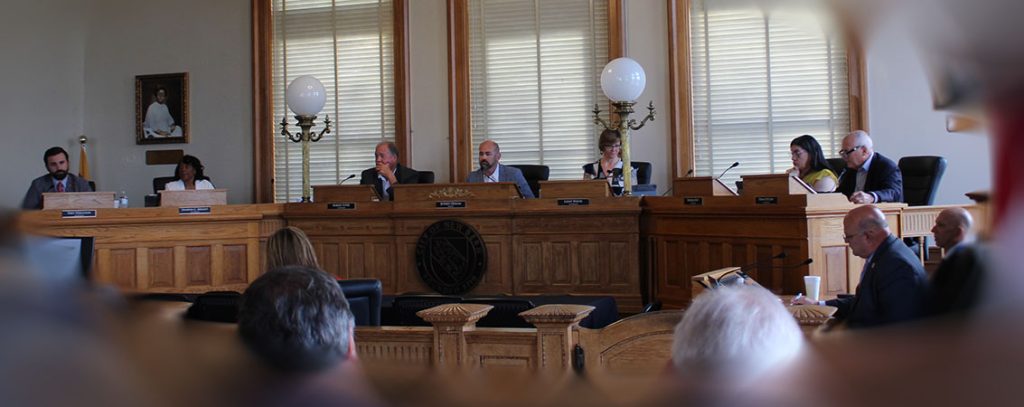
The Board of Aldermen met at City Hall in New Bern, NC. Find the meeting agenda and packet here.
Aldermen Trey Ferguson (Ward 1), Sharon Bryant (Ward 2), Bobby Aster (Ward 3), Lainy White (Ward 4), Barbara Best (Ward 5) and Dana Outlaw (Ward 6) approved a motion to “allow submissions for the second public comment period until that item is called so citizens can submit throughout the meeting up until when the second public comment period is called.”
Public comment period
One person signed up to speak for four minutes, but Mayor Jeffrey Odham told him he couldn’t because his topic “does not meet the level of an agenda item.” The speaker questioned the mayor’s call and Odham hit the gavel, as reported here. The aldermen were silent.
Consent agenda
Several items were lumped on the consent agenda and approved with one vote without discussion. Some items included resolutions that allowed for the temporary closure of streets; initiated the upset bid process for 623 Second Ave., 2302 McKinley Ave.; renamed Leroy Way Jr Avenue to Coach Leroy Way Jr Avenue. It was E. Street until it was renamed in May, as reported here. The board also set a public hearing to close portions of Biddle Street, F Street, Fowlers Lane and K Street in July.
Annexation
The board approved Magnolia Investors application to annex 5.86 acres of land at 4095 E US 70 Highway (tax parcel IDs: 7-037-017 and 7-034-02) into the city. City Attorney M. Scott Davis said the applicant hadn’t advised the city of the proposed use. When the board approved the Water and Sewer Use Agreement for the property in May, the plan was to develop the property commercially. The average daily water and sewer demand was estimated at 5,150 gallons.
Rezone 1100 Pine Tree Drive
The board approved O’ Brien Family Wellness, Inc. application to rezone 3.87-acres at 1100 Pinetree Drive (Parcel ID: 8-212-21000) from R-10A Residential to C-5 Commercial after holding a public hearing where Jackie O’Brien, Director of Paws of War of Eastern North Carolina, thanked the city and supporters for working with them on the request, as reported here.
Land Use
When the aldermen considered rezoning 1100 Pine Tree Drive in March 2026, they found the initial request inconsistent with the land use ordinance. The nonprofit said they was trying to find a place where dogs can be trained inside and outside that had green space. The board directed staff to initiate a text amendment to the ordinance for therapy/service animal training and asked if the applicant would apply for a C-5 rezoning request to use land, as reported here.
In April, staff presented proposed changes to the ordinance to the city’s Planning and Zoning Board, who voted to recommend the changes to the Board of Aldermen. It was noted that the city’s Board of Adjustment would make the final decision to issue special use permits for dog training, not the city council (if the ordinance changes are approved), as reported here.
The aldermen adopted an ordinance on June 9 that added animal service uses related to boarding and dog training and removed the kenneling use to the LUO.
Community Development Block Grant 2026 Annual Action Plan
A Community Needs Public Hearing was held in January; and the aldermen held a public hearing for the Annual Action Plan on April 14. During the April hearing, former Alderman Jameesha Harris told the board, “So, I just want to say that when it does come to you, I hope that you do support it (CDBG Plan). There’s a lot of projects that I know that were presented. There is a community group that put in an application for the funds. So, it’ be great to be able to see that it’s approved because it’s going into the Craven Terrace area. So, we would really hope that you pay attention, read all the information, study, and say yes,” The meeting video can be found here.
We later asked Jameesha Harris in an email what community group was she talking about and what was their request? She had not responded by press time.
The hearing was continued until May 12 because the city had not received HUD’s funding allotment of CDBG funds. Development Services Director Jessica Rhue said there were certain caps on how much money they can spend on demolitions. “We have several projects from program years that are taking us longer than we ever anticipated to get closed out. Basically, I would attribute that to federal requirements changing particularly on construction projects where they are adding more and more requirements but giving us less and less money. Sometimes by the time these projects receive bids, it’s difficult to complete them with the original budget and then that is why sometimes you see me coming back here asking to move money from one program year to a separate program year,” she said.
She said she was pretty confident that they wouldn’t be able to meet the timeliness test due to one outstanding construction project. She said they were looking at other things they had done in “previous years in drawing that money down. And many times, that means working with a partner on assistance types of programs or it means running a program or doing a construction program in-house. Meaning, the city controls the project, and it doesn’t deal with all the bidding and some of the other federal things that come when somebody else does that project.”
She said they were addressing three strategies in the Five-Year Consolidation Plan and noted four projects, including $48,063 in administrative costs for things like the in-house roofing project and it helps pay the CDBG Coordinator Fulmore’s salary; $127,251 to reconstruct streets and sidewalks in low-to-moderate income locations; $40,000 to finance owner-occupied roof replacement activities; and $25,000 will be used to provide utility assistance to low-income households that was proposed to be run by Abundant Life (Community Services). She said the amount of money they received this year is $20,000 less than last year.
The director said they had $42,000 from the 2022-line item for HVAC and hot water heater repair. She said she told the board in January that they were trying to help some people but were running into a problem because the program is $10,000 for HVAC repair only. She noted it was becoming a problem because so many people needed HVAC units and they also needed electrical work to be done to prepare the structure to be able to accommodate a modernized HVAC system. “We’re seeing even more complications now where occasionally we run into they need to cut a new hole for some of this equipment and that that bumps in testing for asbestos and lead paint on something as simple as trying to get an HVAC unit in.”
The director said they were recommending roofs as a pilot program because there’s “less permitting and construction type work to vet a new roof than there is on some of these other things. And there’s still outstanding money in the 2022 program for HVAC assistance.” It was said it would cost about $10,000 to repair a medium-small home.
NewBernNow.com asked who will do the roofing and HVAC work and the CDBG coordinator said they receive three bids from their list of contractors and choose the lowest bidder.
HUD allocated $240,314 for the program and the board adopted the plan which will be submitted as the application to receive the funds.
Additional streetlight
The aldermen approved Victor Dove’s request to add an additional streetlight along E. F. Thompkins Lane.
Power-Up grant application
The board authorized the submission of a Power-Up grant application for $2 million to the NC Department of Environmental Quality State Energy Office to help with resiliency of electric grants and prevent outages. The Department of Public Utilities Director Charles “Charlie” Bauschard said the city would be required to match 33% or $660,000 which could be in-kind services. The scope of work includes the department’s five-year capital plan (estimated to cost $98,802,000), as reported here.
The mayor lumped the next two items together and aldermen Ferguson, Bryant, Aster, White, Best, and Outlaw approved the items.
Subaward and Monitory Policy — Grant funds
The Subaward and Monitory Policy “establishes formal procedures for administering and monitoring grant funds that the city may pass through,” according to Finance Director Kimberly Ostrom. The Finance director later told us that it pertained to CDBG grant subrecipients – “Catholic Charities; My Sister’s House; Lyfe Three, Inc; The Village; Trial by Fire; and the Omega Center” and “USDOJ COPS grant subrecipient is RHA Health Services.”
Revised Capital Assets Policy
The Capital Assets Policy was revised “to address GASB Statement No. 104”. The Finance Director Ostrom later told us that the revisions included 2 updates:
– “GASB 104 requires the city to evaluate assets that have been approved for sale but not sold prior to June 30th as ‘held for sale’ in the financial statements. At this time there are no “held for sale” assets to report.”
– “A GASB 96 SBITA threshold of $75,000 was established, so all SBITAs (subscription-based information technology arrangements) that meet or exceed that threshold will be reported.” She said the city’s arrangements include “Axon Enterprise (body worn cameras), Environmental Systems Research Institute (geographic information systems), Granicus (communications), Hansen (sewer system monitoring) NWN (phones, voicemail, etc.), SHI International (Microsoft software), ShotSpotter, and ThinkGuard (cloud backup).”
Vehicle and equipment financing
They approved a $5 million financing agreement with Truist Bank at a 3.85% interest rate to purchase vehicles and equipment.
Truist Bank
The board designated Truist Bank as an additional official depository and created a Public Fund Money Rate Savings Account with the bank “to receive reimbursements of loan proceeds directly into the account. The account is expected to earn interest at money market rates, generating additional interest income while maintaining liquidity and immediate access to funds for project expenditure,” per the meeting packet. First Citizens Bank will shall remain the primary operating depository of the city.
Amend Electric Service Schedule
Department of Public Utilities Director Charlie Bauschard reported that the aldermen approved changes to the city’s electric rate ordinance on March 10, 2026, which included adopting a new solar rate. “At the same time, they made the existing solar rate obsolete to new customers. That action did not translate transfer through to when the most recent amendment occurred in April. The board adopted an amendment to the Electric Service Schedule on June 9, which the director said corrected the error.
Abandoned Vessels
The aldermen approved an ordinance that changed the Waterways chapter to add Article 3 – Abandoned Vessels to regulate removal and disposal of abandoned vessels. The city attorney said they are looking at extending the city limits to the center of the rivers in
areas, as previously reported here.

Honor/memory swing
The board approved an amendment to the city’s Schedule of Fees and Charges which adds $2,500 for an honor/memory swing. The city’s website says, “… Through this (Memory Bench Program), individuals and families can sponsor a bench in various park locations, providing a place for rest, reflection, and connection for years to come.”
Multi-Year Grants Fund
They amended the multi-year grants fund to recognize a grant for $15,203.13 from the Bureau of Justice Assistance’s Bulletproof Vest Partnership. The grant requires a dollar-for-dollar match, which will come from the Police Department’s FY2027 budget.
City attorney’s report
City Attorney M. Scott Davis introduced a resolution that changes the Board of Aldermen’s Rules of Procedure to allow people to submit Request & Petition of Citizens Sign-In Sheets “Non-Agenda-Related Topics” throughout the course of the meeting if they want to speak at the end of the meeting and the aldermen adopted it.
The Rules of Procedure don’t mention non-agenda related topics and the aldermen did not formally vote to create two public comment periods. The current Rules of Procedure say the mayor could move the comment period if he determines that the “time required to hear all speakers would unduly disrupt the conduct of city business or cause undue inconvenience to citizens.”
City Manager’s report
City Manager Foster Hughes talked about power washing and construction projects (in the Municipal Service District). He said the Administration, Finance, Development Services, Parks and Recreation, Public Works departments and the Electric Utility received safety awards from the NC Department of Labor.
New Business
Outlaw asked for an update on construction on Simmons Street (a state road) but Hughes didn’t have one from NCDOT.
Bryant made personal congratulatory remarks.
Aster asked for an update on the no-wake zone in Brices Creek Quarry. The city manager said the state wants the city to adhere to the process which includes an assessment from NC Wildlife.
White said she had been working with the Redevelopment Commission. She also said the Fire Department had been recommended for reaccreditation, “which helps us in our city keep all our insurance rates low.”
Ferguson said Swiss Bear “received a $10,000 grant from ElectriCities to go towards their downtown development plan.”
The board approved a motion to hold a summer retreat on June 16 at 9 a.m. at Stanley White Recreation Center.
Odham said they had been doing the city manager’s annual evaluation via survey monkey for the last couple of years with a “standard list of questions. Everybody can fill that out at your leisure. Um hopefully you do it not wait too long. And when we get that together, uh, probably at our next board meeting, at the conclusion of that meeting, we will go into close session and discuss the manager’s performance with him…
Public comment period
During another “Requests and Petition of Citizens” period, David French said he was protesting the mayor’s “juvenile unilateral decision to push the people of New Bern to the back of the bus with his moving of the petition of citizens non-agenda items to the end of the meeting. Why cannot we the people be heard at the beginning as has been done for decades? Why would he restrict, restrain, and delay us?…”
Tyrone Brown said he was a pastor, civil rights activist, and advocate and said he was “there because of the fundamental principles of our democracy is under siege right here in our backyard. That principle is simple yet absolute. No individual, no matter their title, badge or bank account is above the law. Elected officials are chosen to serve the people, not rule over them with impunity…”
Jesse Mars thanked the city for their support with the Juneteenth event. He said the event is dedicated “to promoting education, celebrating advocacy, and community empowerment while honoring the contributions of African Americans past, present, and future. Our work extends beyond a single event and seeks to strengthen community connections through history, culture, education and service…” He also referred to agenda item 17 and said, “EF Tomkins Lane doesn’t exist in the city.”
Another person voiced concerns with the 35-mph speed limit on Queen Street. He said it’s a business district and a residential area and noted his chances were better pulling out at the speed limit 25 than it is at 35 and 40. “It’s a narrow street and if you got cars parked on both sides, someone open the door, people have to go over in the other lane, you know, to avoid hitting them or something like that. You have parents out there putting kids in their cars, people crossing the street with laundry basket, older senior citizens from home over there on West Street trying to get across the street…” He thought 35 mph is too much for the area and asked them to address the issue and consider lowering the speed limit back to 25. He also said, “I appreciate everything you’ve done be you know thus far, but I am asking you do this again for me.”
NewBernNow.com said the electric review ad-hoc committee had met three times, but the meeting schedule isn’t published ahead of time. We asked if NC Open Meeting Laws applied to the committee.
Mayor Jeffrey Odham said, “There’s no quorum.”
City Attorney Davis said, “The board did not create a public body, so the rules don’t apply. They’ve obviously made the decision to allow the public to attend, but it’s not a constituted public body, so it’s not required to publish a notice of meetings or to even to have an open meeting. I think they’re doing that as a matter of courtesy.”
The editor asked, “So, the meeting minutes are out of courtesy. They’re not because it’s required by law?”
“Exactly,” Davis said.
The editor referred to the comment about the ex-officio members of the Redevelopment Commission reporting back to the Board of Aldermen and asked if the mayor is reporting what is happening at the Housing Authority (of the City of New Bern) Board of Commissioners meetings and the status of the Walt Bellamy houses and other things because city (General Fund) monies were used.
The city attorney said the mayor appoints the members. “Otherwise, the city has no relationship with the housing authority at all.”
The editor asked if updates were being provided behind closed doors or will they be discussed during an open public meeting?
The city attorney asked what updates the editor was talking about.
The editor said the (Choice Neighborhood Implementation) grant request. The board (of aldermen) never talks about the housing authority, but the city’s (General Fund) monies are being used to fund the housing authority (projects). So, I’m just wondering if that was a requirement. Obviously, you said it wasn’t. So, thank you.”
Mayor Odham (of Ward 6) also voted on all the above motions.
Closed session
The board went into closed session to talk about “the potential acquisition of real property and to maintain our attorney.
NewBernNow.com later asked Mayor Pro Tem Aster for more information about the request for a no-wake zone. We have not received a response by press time.
Food for thought
Saving time or censoring citizens?
During the newly elected Board of Aldermen’s first full meeting in office, the mayor told them he had the right to move the public comments and asked them to let him do it, as reported here. If he had the right, why was he asking for permission?
The aldermen’s rules say the mayor ‘could move’ the comment period if the mayor determines that the “time required to hear all speakers would unduly disrupt the conduct of city business or cause undue inconvenience to citizens.” The rules don’t say the mayor has the right to decide who can speak first based on what he thinks they are going to say, nor did the aldermen formally vote on a measure that gives him that kind of authority.
This new practice is letting some citizens speak at the beginning of the meeting and then leave, while other citizens have to wait 1-3 hours or longer to petition their city council based on what the mayor thinks the speaker will say — not because of the “time required.”
What does it mean for citizens who want to petition their elected representatives?
If the mayor tells you that your topic “does not meet the level of an agenda item,” you may have to pay more for a babysitter and wait 1-3 hours or longer to address your city council; you may have to pay more for your caretaker; you may have to pay more money to park at the Craven Street Pay-to-Park Lot, you may have to take more time off from work, and the list goes on.
The resolution that the city attorney presented in the middle of the meeting adds a sign-up sheet for “Non-Agenda-Related Topics.” The rules don’t define what meets “the level of an agenda item.” The citizen who the mayor prevented from speaking at the beginning of the meeting returned at end of the meeting and talked about an agenda-related topic. Was this a “time” saver or censorship?
The Open Meeting Requirements noted in the rules state, “The board shall not deliberate, vote, or otherwise take action on any matter by reference to a letter, number or other designation, or other secret device or method, with the intention of making it impossible for persons attending a meeting of the board to understand what is being deliberated, voted, or acted on. However, the board may deliberate, vote, or otherwise take action by reference to an agenda, if copies of the agenda— sufficiently worded to enable the public to understand what is being deliberated, voted, or acted on— are available for public inspection at the meeting.” The resolution that Davis presented to the board was not on the agenda and it was not available for public inspection.
Sixteen years ago, A. Flemming Bell, professor of Law at the University of North Carolina School of Government, came to New Bern and explained the roles and responsibilities of the city council, known locally as the Board of Aldermen, and the mayor’s role, according to the Jan. 10, 2010 meeting minutes.
He said the mayor’s role is “to provide for orderly, fair meetings where the majority rules, but the minority is heard.” The mayor is the presiding officer and has to treat everybody fairly — “make your decisions based on the merits, not on manipulating the rules.”
Bell also explained the board and mayor have to be consistent about how rules are applied; “The mayor interprets the board’s rules, but the members can appeal the mayor’s rulings to the council,” he said. “They’re still the council’s rules so, if the council wants to disagree with the mayor on an interpretation, they ought to be able to do that by majority vote,” he said.
He said it’s often considered a point of fairness, if and when, the mayor wants to get involved in the debate, they can turn the gavel to the mayor pro tem. If the mayor pro tem gets involved, then they pick another council member. If all members are involved, then they pick the manager, clerk, attorney or someone else to preside. “But the point being, you want to have fairness. Again, fairness is a key thing in a meeting.”
Does fairness still matter?
If so, maybe it’s time for the city to ask the School of Government to present refresher training to the Board of Aldermen and mayor during a public meeting.
Related news:
The aldermen meeting schedule can be found here. Meeting agendas and packets can be found here. Video of the meetings are available on the city’s Facebook page, City 3 TV and YouTube channel.
By Wendy Card, Editor. Send an email with questions or comments.