

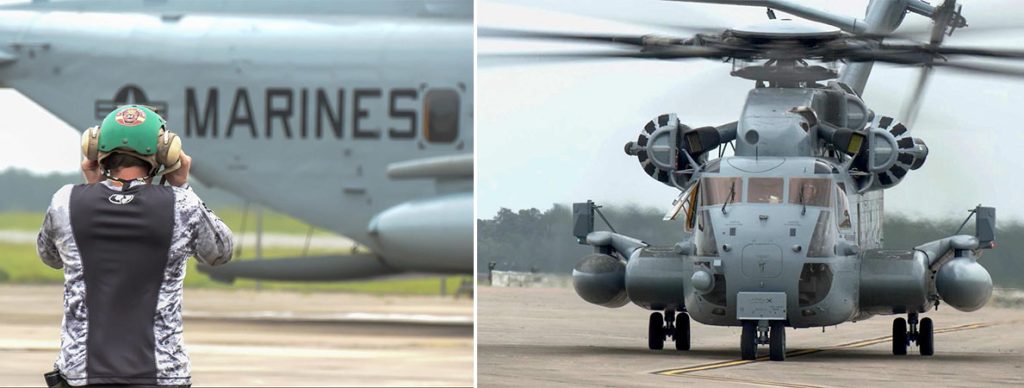
A commitment to flight line safety and efficiency has earned Fleet Readiness Center East recognition from the Chief of Naval Operations with the CNO Aviation Safety Award for fiscal year 2025.
The award, also known as the Navy’s Safety “S,” is presented annually to Navy and Marine Corps aviation units to honor superior operational performance and mishap prevention efforts throughout the fiscal year. Unlike single-winner awards, this recognition is given to multiple commands across the Navy enterprise that meet the rigorous safety and operational standards set by the Naval Safety Command. FRCE became one of just 48 organizations within the Navy chain of command to receive the accolade for 2025, and one of only two within Naval Air Systems Command.
FRCE Commanding Officer Capt. Randy Berti said this accomplishment was made possible by the hard work and dedication of the depot’s workforce coming together in support of the warfighter.
“FRC East’s primary mission is to ensure that our nation’s Marines, Sailors and Airmen are equipped with the safest, most reliable products,” said Berti. “We are committed to maintaining our record of zero flight mishaps and further enhancing our operations through safe practices. Our success is driven by a workforce that has fully embraced our safety management systems, knowing the vital role they play in our nation’s defense. This deep-rooted culture of safety not only protects our people but also guarantees that every aircraft, engine and component we deliver is fully mission-ready, every time.”
This achievement represents the FRCE’s eighth CNO Aviation Safety Award, and the second time since 2013, adding to the command’s previous wins in 1984, 1991, 1996, 2004, 2010 and 2023.
In fiscal year 2025, FRCE logged nearly 200 flight hours and returned 81 mission-capable aircraft back to the fleet. This flight line support was delivered across five types of aircraft for the U.S. Navy, Marine Corps and Air Force: The F-35 Lightning II, MV-22B Osprey, MH-53E Sea Stallion, CH-53E Super Stallion and UH-1N Huey.
With a team of only six pilots – four military and two civilian – and five enlisted military aircrew members completed nearly 140 flights in fiscal year 2025. These flights included functional check flights that check the aircraft’s systems and performance and ferry deliveries of aircraft as they return to their home squadrons. FRCE H-53 Military Branch Head Marine Capt. Robert McGuire, who serves as the command’s aviation safety officer, said of the 140 flights and 200 flight hours, the team experienced no mishaps. McGuire credits this success to the depot’s highly effective safety management systems and dedicated workforce.
“As a command, especially one that performs such in-depth maintenance, we do a really good job maintaining the safety of our people and products,” said McGuire. “We haven’t had a Class A mishap in 28 years, and it’s been about 47 years since our last Class B or C mishap. I believe our excellent record is a result of our safety management systems; our employees and leadership continue to work hand-in-hand to foster a safety-first culture that ensures hazards are identified, mitigated and resolved. These efforts are critical in maintaining both a safe working environment and a continued high standard of flight safety once aircraft leave our hangars.”
As part of the depot’s safety management system, every aircraft, component and part is subjected to rigorous quality and assurance inspections, foreign object debris checks, and general safety inspections. McGuire said he believes these checks, some of which go above and beyond the naval aviation standard, are how FRCE maintains such an excellent aviation safety record.
“Because we do such in-depth maintenance – completely tearing every aircraft, engine and component down to the bolts for overhaul – we also have many mandatory safety checks embedded throughout the maintenance process to ensure everything is working accordingly before it goes back out to the fleet,” McGuire said. “Not only do we have our safety team focused on employee safety, but we also have our quality assurance team, logs and records professionals and maintenance controllers who are constantly checking and rechecking the safety of our aircraft and components.”
In addition to verifying the safety and quality of the products FRCE maintains, the command has also implemented daily foreign object debris inspections, according to McGuire. He said these inspections are conducted on the flight line, in aircraft hangars and in back shops to ensure workspaces remain free of hazards.
In 2025, FRCE updated its aviation safety management system to further enhance the command’s safety policies and procedures, McGuire said.
“Safety is an ongoing thing; changes are always happening to keep up with the best and safest way of doing things,” said McGuire. “As of last year, the aviation safety management system was completely overhauled, which included many audits. We have made sure to incorporate all those changes and new information into our local instruction to ensure we have the best system in place to protect our people and the fleet’s products.”
The command also made upgrades to its facilities, improving lighting and adding freshly painted pavement markings on the depot’s flight line to allow for a safer and more efficient working environment, McGuire said.
“In 2025, we installed advanced lighting systems to improve visibility and safety during nighttime operations,” said McGuire. “We also repainted all of our taxiway lines and parking spots. They’re now easy to see and organized in a way to limit congestion when we have multiple aircraft on our flight line. We also audited our aircraft pickup and drop-off procedures. Because we have a non-standard flight line, we established clear instructions – complete with visual guides and updated wingtip clearances. These improvements are extremely valuable for non-local pilots who have not been here before because they eliminate confusion and drastically lower the risk of a mishap.”
Through proactive safety measures, FRCE is able to lower risk and mitigate delays, saving time and maximizing fleet support, McGuire said.
“If we are doing things the safe way the first time, then we are able to avoid having to repeat processes or use extra time to fix mistakes,” McGuire said. “Aircraft get back to the fleet sooner, giving them the products they need to enhance readiness even faster. We ensure the maintenance is done properly throughout every step here and because of that, the fleet knows when they get a product from FRC East, they can trust that it’s safe to use and is working properly.”
FRCE is North Carolina’s largest maintenance, repair, overhaul and technical services provider, with more than 3,600 civilian, military and contract workers. Its annual revenue exceeds $886 million. The depot provides service to the fleet while functioning as an integral part of the greater U.S. Navy; Naval Air Systems Command; and Commander, Fleet Readiness Centers.
Submitted by Rebecca McGann, Fleet Readiness Center East